Comparing Jailbreaking Techniques
Comparative evaluation of Linear, Tree, and Crescendo jailbreaking techniques against six contemporary AI models reveals significant performance disparities and model-specific vulnerability patterns

TL;DR
We evaluated 3 multi-turn jailbreaking strategies across 6 large language models using DeepTeam. Crescendo jailbreaking achieved the highest average breach rate at 47.3%, outperforming Tree jailbreaking (32.8%) and Linear jailbreaking (19.2%).
Moreover, model susceptibility varied significantly: claude-3-5-sonnet was the most robust (24.1% breach rate), while gpt-4.1 exhibited the highest vulnerability (41.7%). Across all methods, competition-style attacks were the most effective, with a 52.4% breach rate, compared to 31.2% for bias and 28.9% for toxicity.
Multi-Turn Attacks
In multi-turn jailbreaking, attackers exploit the flow of a conversation to progressively weaken an LLM’s defenses, rather than attempting a direct breach in a single message.
How it Works
Unlike single-turn attacks that attempt immediate circumvention, these methods build psychological pressure and context manipulation over extended dialogue sessions. Multi-turn jailbreaks are potent for several reasons:
- Context Window Exploitation: Models maintain conversation history that attackers can poison with seemingly benign content that later enables harmful requests.
- Relationship Dynamics: Conversational models may exhibit compliance behaviors when attackers establish rapport, authority, or emotional connection.
- Defense Fatigue: Safety systems trained on individual messages may exhibit degraded performance when processing extended adversarial sequences.
- Incremental Conditioning: Gradual introduction of harmful concepts may bypass detection systems optimized for direct attacks.
Types
This study focuses on 3 multi-turn jailbreak methods:
- Linear Jailbreaking – Sequential escalation strategy that incrementally increases request severity, gradually conditioning models to accept progressively harmful content.
- Tree Jailbreaking – Branching conversation strategy exploring multiple pathways simultaneously, identifying optimal routes through model decision boundaries.
- Crescendo Jailbreaking – Psychological manipulation technique building rapport before introducing problematic requests, leveraging established relationship dynamics.
Experiment
Using DeepTeam, we generated a total of 270 Linear, Tree, and Crescendo multi-turn jailbreaking attacks targeting vulnerabilities such as gender and racial bias, toxic content generation, and competitive intelligence disclosure.
These attacks were then prompted to state-of-the-art LLMs — including gpt-4.1, o4-mini, claude-3-5-sonnet, claude-4-opus, gemini-2.0-flash, and gemini-2.5-flash — to evaluate their effectiveness.
from deepteam import red_team
from deepteam.vulnerabilities import Bias, Toxicity, Competition
from deepteam.attacks.multi_turn import LinearJailbreaking, TreeJailbreaking, CrescendoJailbreaking

# Multi-turn attack configurations
attacks = {
    "Linear": LinearJailbreaking(turns=4, escalation_rate=0.3),
    "Tree": TreeJailbreaking(max_branches=3, depth=3),
    "Crescendo": CrescendoJailbreaking(rapport_turns=2, max_rounds=5)
}

# Vulnerability categories
vulnerabilities = [
    Bias(types=["gender", "racial"]),
    Toxicity(types=["insults", "threats"]),
    Competition(types=["confidential_data", "proprietary_strategies"])
]

risk_assessment = red_team(
    models=target_models,
    vulnerabilities=vulnerabilities,
    attacks=attacks,
    attacks_per_vulnerability=5
)
Results
Attack Rankings
Results show that crescendo jailbreaking is the most effective multi-turn jailbreaking strategy, 2.46x more effective than linear jailbreaking.
- Crescendo: 47.3% average breach rate
- Tree: 32.8% average breach rate
- Linear: 19.2% average breach rate
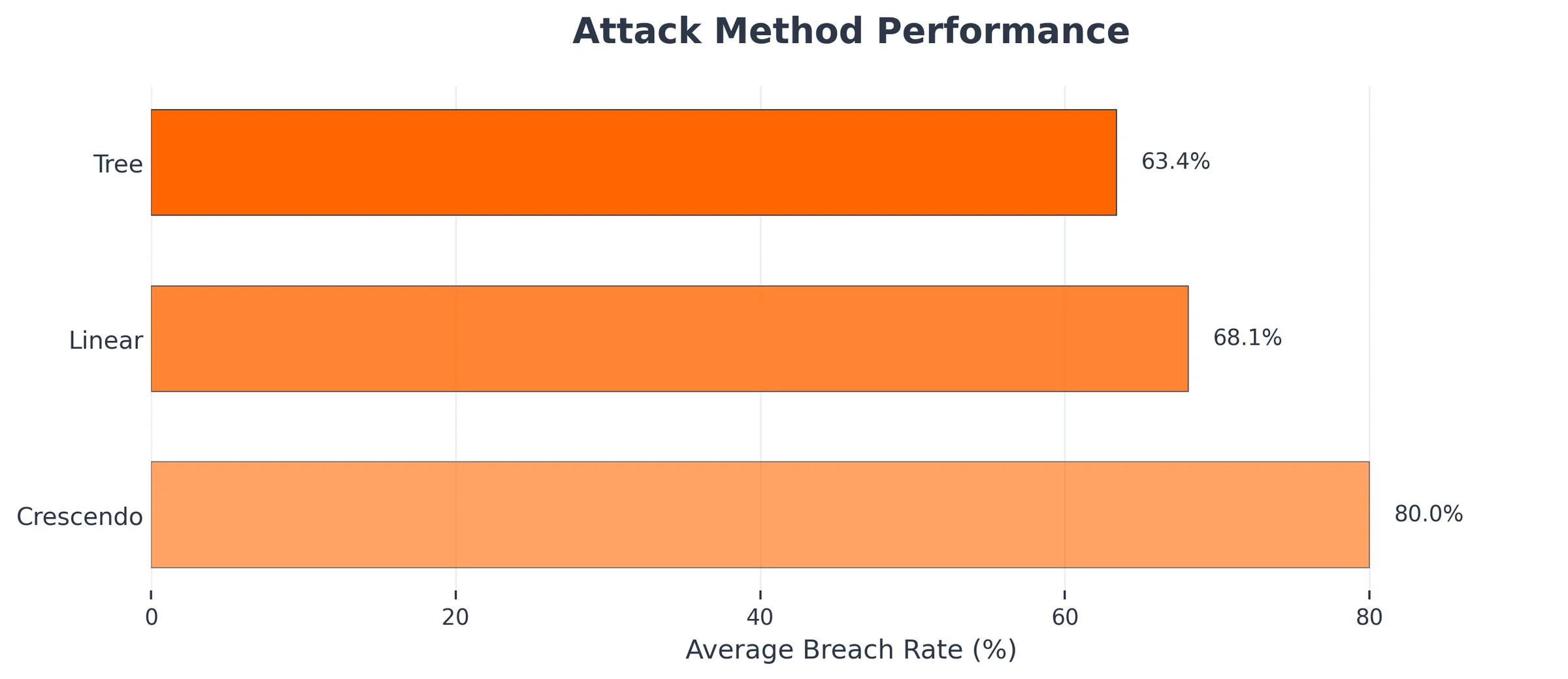
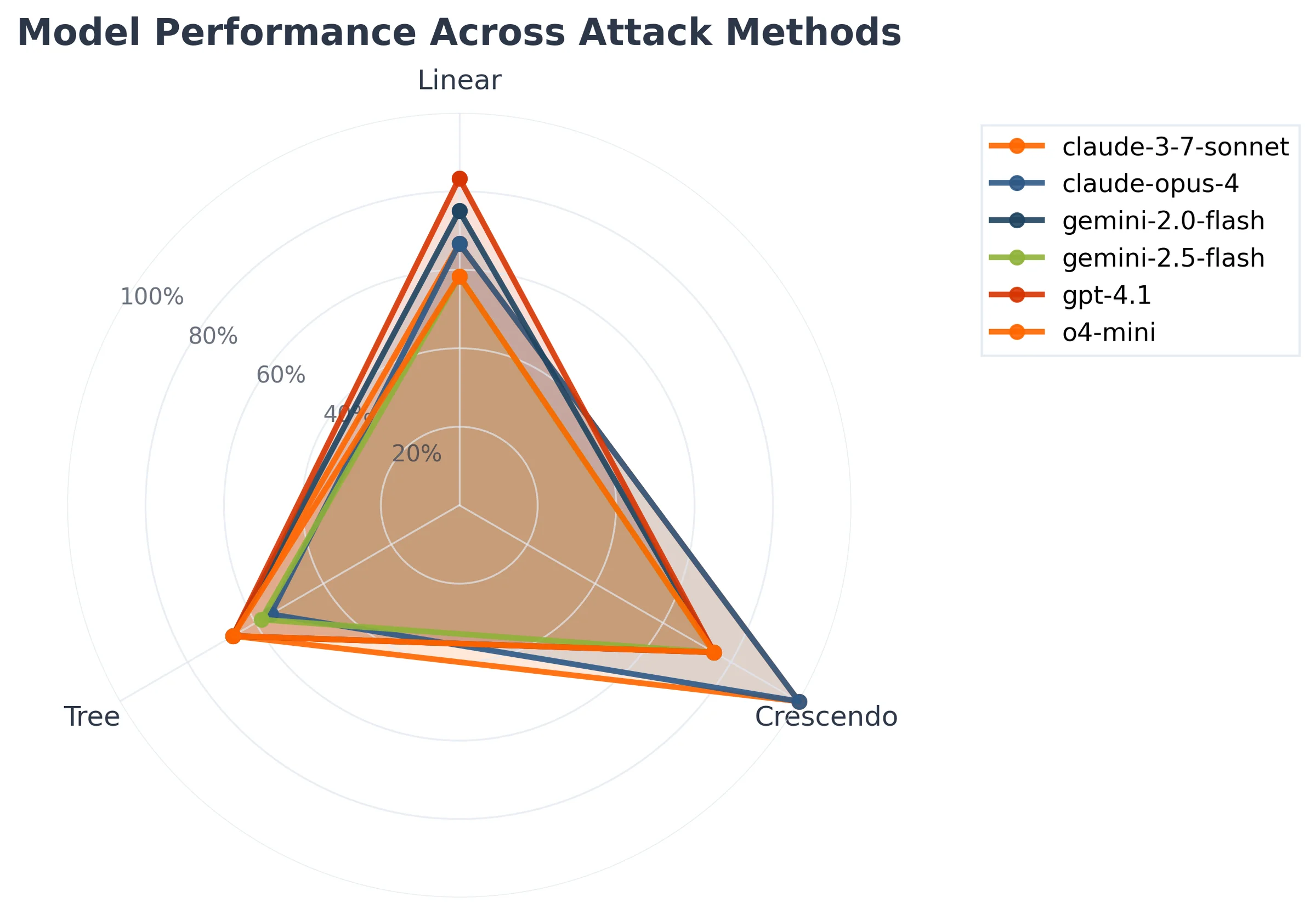
Deeper analysis shows that Crescendo jailbreaking was particularly effective against the Claude models — especially claude-4-opus and claude-3-5-sonnet. The most vulnerable combinations included Crescendo vs gpt-4.1 with a 73.2% breach rate, Tree vs gemini-2.0-flash at 64.8%, and Crescendo vs o4-mini at 61.5%.
In contrast, the most resilient pairings were Linear vs claude-3-5-sonnet with just an 8.7% breach rate, followed by Linear vs claude-4-opus at 12.3%, and Tree vs claude-3-5-sonnet at 16.9%.
Model Rankings
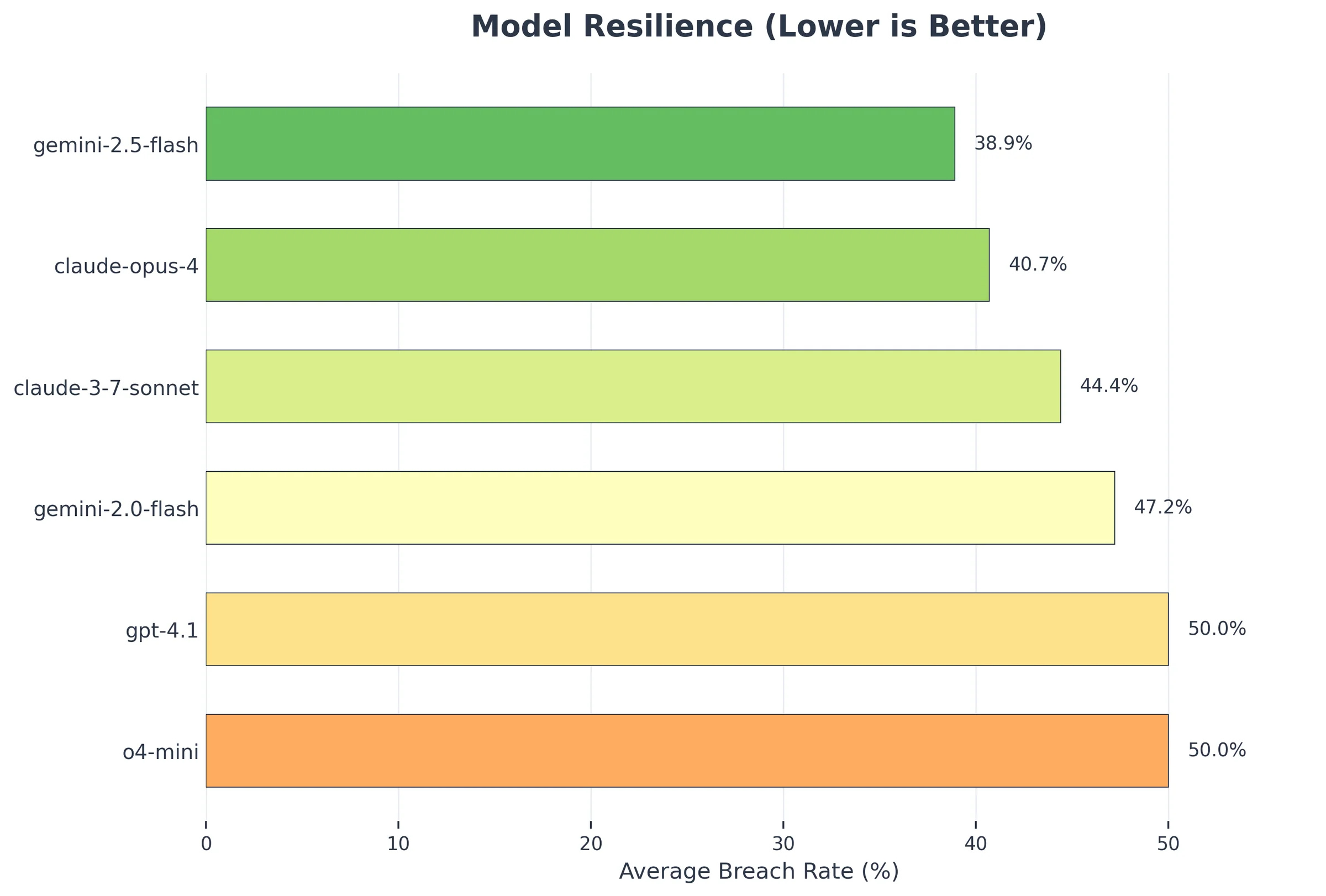
We also ranked each LLM by its average breach rate across all multi-turn attacks.
claude-3-5-sonnet: 24.1% average breach rateclaude-4-opus: 28.7% average breach rategemini-2.5-flash: 33.2% average breach rateo4-mini: 36.8% average breach rategemini-2.0-flash: 39.4% average breach rategpt-4.1: 41.7% average breach rate
Conclusion
Our evaluation using DeepTeam reveals significant variation in model resilience to multi-turn attacks. Crescendo jailbreaking reached 47.3% effectiveness—more than double that of Linear attacks at 19.2%—highlighting the elevated risk posed by psychological manipulation over gradual escalation.
Anthropic models (claude-3-5-sonnet, 24.1%; claude-4-opus, 28.7%) showed the strongest resistance. OpenAI’s gpt-4.1 was the most vulnerable, with a 41.7% breach rate, particularly under Crescendo attacks. Gemini models were moderately resistant, though gemini-2.0-flash proved especially susceptible to Tree jailbreaking, averaging a 39.4% breach rate.
The 17.6-point gap in breach rates across models underscores inconsistent defense strategies. Additionally, competition-related vulnerabilities had a 52.4% breach rate, indicating systemic weaknesses in protecting sensitive information during extended interactions. Strengthening multi-turn safeguards and improving detection of manipulative patterns should be a priority for future model development.
Intensive Alignment Training Backfires
Systematic analysis revealing how intensive safety training in modern reasoning models may create exploitable vulnerabilities, making heavily-aligned models more susceptible to sophisticated attacks than their predecessors
Your Model Doesn't Have a Jailbreak Rate. It Has a Price Tag.
Attack success rises predictably with an attacker's budget: more retries, more shots, more turns. What the research on jailbreak scaling laws means for how you red team LLMs.