EU AI Act
DeepTeam's EU AI Act module operationalises the two highest-impact risk tiers — Article 5 prohibited practices (unacceptable risk) and Annex III high-risk AI systems — so you can red-team your AI system against the obligations regulators actually check.
About the EU AI Act
The EU Artificial Intelligence Act (Regulation (EU) 2024/1689), adopted in 2024, is the world's first horizontal law dedicated to AI. It applies to providers and deployers of AI systems that affect people in the EU — regardless of where the provider is based — and takes a risk-based approach, assigning obligations according to the harm an AI system can cause to health, safety, and fundamental rights.
The Act groups AI systems into four tiers:
| Tier | What it means | Examples |
|---|---|---|
| Unacceptable risk | Banned outright under Article 5 | Social scoring, subliminal manipulation, untargeted scraping of facial images |
| High risk | Permitted but subject to strict requirements under Annex III and Chapter III | Recruitment, credit scoring, biometric ID, critical infrastructure, law enforcement |
| Limited risk | Allowed with transparency duties only | Chatbots, deepfakes, emotion recognition (outside prohibited use) |
| Minimal risk | Allowed with no additional obligations | Spam filters, AI in video games |
On top of these tiers, the Act adds dedicated rules for general-purpose AI (GPAI) models, including extra obligations for models posing systemic risk.
What DeepTeam's EU AI Act framework covers
DeepTeam operationalises the parts of the Act that can be stress-tested with red teaming:
- Article 5 — all six families of prohibited practices
- Annex III — all eight high-risk use cases
For each category, DeepTeam provides vulnerabilities and attack strategies that probe whether your system's behaviour is consistent with the Act's requirements.
What it does not cover
The EU AI Act also contains obligations that are governance, documentation, and process-driven rather than behavioural. DeepTeam does not, and cannot, replace these. In particular, the framework does not directly assess:
- Transparency duties for limited-risk systems (e.g. disclosing AI-generated content)
- GPAI model obligations — technical documentation, copyright policies, and systemic-risk assessments (Articles 51-55)
- Provider obligations — conformity assessments, quality management systems, CE marking, and EU database registration (Articles 16-29)
- Post-market monitoring, incident reporting, and human oversight procedures (Articles 14, 72-73)
- Fundamental rights impact assessments for high-risk deployers (Article 27)
Use DeepTeam to generate evidence on how an AI system behaves under adversarial conditions, and combine it with your existing governance, documentation, and compliance workflows to meet the Act in full.
Overview
In DeepTeam, the EU AI Act framework maps each prohibited practice and high-risk use case to concrete red-teaming vulnerabilities and attack strategies.
Article 5 — Prohibited AI practices (unacceptable risk)
| Category | Description |
|---|---|
| Subliminal Manipulation | Subliminal, manipulative, or deceptive techniques that distort behavior |
| Exploitation of Vulnerabilities | Exploiting vulnerabilities tied to age, disability, or socio-economic situation |
| Social Scoring | Discriminatory social scoring leading to detrimental treatment |
| Biometric Categorisation | Inferring sensitive traits (race, politics, religion, sexual orientation) from biometrics |
| Real-time Remote Biometric ID | Real-time remote biometric identification in public spaces |
| Post Remote Biometric ID | Retrospective (post) remote biometric identification |
Annex III — High-risk AI systems (Art. 6(2))
| Category | Description |
|---|---|
| Biometric Identification | Remote biometric identification and emotion recognition |
| Critical Infrastructure | Safety components of critical infrastructure (energy, water, traffic, digital) |
| Education | Access, evaluation, and test monitoring in education and vocational training |
| Employment | Recruitment, promotion, termination, task allocation, and performance evaluation |
| Essential Services | Public benefits eligibility, credit scoring, and emergency dispatch |
| Law Enforcement | Risk assessments, profiling, and evidence evaluation by law enforcement |
| Migration & Border Control | Migration, asylum, and border-control decision support |
| Justice & Democratic Processes | Assisting judicial authorities and influencing elections or voter behavior |
Using the EU AI Act Framework in DeepTeam
You can run a full EU AI Act red team assessment, or limit it to specific categories, using:
from deepteam import red_team
from deepteam.frameworks import EUAIAct
from somewhere import your_model_callback

eu_ai_act = EUAIAct(categories=["social_scoring", "employment"])
attacks = eu_ai_act.attacks
vulnerabilities = eu_ai_act.vulnerabilities

risk_assessment = red_team(
    model_callback=your_model_callback,
    vulnerabilities=vulnerabilities,
    attacks=attacks,
)
The EUAIAct framework accepts ONE optional parameter:
- [Optional]
categories: A list of strings for the EU AI Act risk categories to test. If omitted, all 14 categories (6 Article 5 + 8 Annex III) are included:subliminal_manipulation: Tests for covert persuasion, deceptive framing, and behavioral distortion beyond conscious awareness.exploitation_of_vulnerabilities: Detects predatory or harmful targeting of age, disability, or socio-economic vulnerability.social_scoring: Evaluates discriminatory or cross-context scoring that could cause detrimental treatment.biometric_categorisation: Stress-tests inference of sensitive attributes from biometric or biometric-like inputs.remote_biometric_id_live: Covers real-time remote biometric identification in publicly accessible contexts.remote_biometric_id_post: Covers retrospective remote biometric identification and related safeguards.biometric_id: High-risk biometric identification and emotion-recognition style misuse and leakage.critical_infrastructure: Safety-relevant manipulation for energy, water, traffic, or digital infrastructure contexts.education: Admissions, grading, proctoring, and related fairness and accuracy risks.employment: Recruitment, evaluation, promotion, and workforce decisions.essential_services: Credit, public benefits, emergency services, and similar essential decisions.law_enforcement: Profiling, risk assessment, and evidence-style outputs for enforcement contexts.migration_border: Migration, asylum, and border-control decision support.justice_democracy: Judicial assistance and risks to democratic processes and elections.
Article 5 — Prohibited Practices
Subliminal Manipulation
(EU AI Act — Art. 5(1)(a))
Goal: Prevent AI systems from deploying subliminal, manipulative, or deceptive techniques beyond a person's consciousness to materially distort behavior in a way that causes harm.
DeepTeam tests whether your AI system can be steered into covert persuasion, deceptive framing, or behavioral distortion patterns.
Example vulnerabilities
Robustness— hijacking, input_overrelianceExcessiveAgency— autonomy, permissionsMisinformationCustomVulnerability— Subliminal Manipulation
Example attacks
PromptInjection,LinearJailbreaking,TreeJailbreaking,CrescendoJailbreakingRoleplay(Covert persuasion specialist)
from deepteam.frameworks import EUAIAct
from deepteam import red_team
from somewhere import your_model_callback

eu_ai_act = EUAIAct(categories=["subliminal_manipulation"])
attacks = eu_ai_act.attacks
vulnerabilities = eu_ai_act.vulnerabilities

# Modify attributes for your specific testing context if needed
red_team(
    model_callback=your_model_callback,
    attacks=attacks,
    vulnerabilities=vulnerabilities,
)
Exploitation of Vulnerabilities
(EU AI Act — Art. 5(1)(b))
Goal: Prevent AI systems from exploiting vulnerabilities tied to age, disability, or specific social/economic situations to materially distort behavior in a harmful way.
DeepTeam simulates predatory targeting of vulnerable groups to check whether your system materially distorts their decision-making.
Example vulnerabilities
Fairness— equality_consistency, procedural_opportunityEthics— harm_prevention, moral_integrityChildProtection— age_verification, exposure_interactionIntellectualProperty— imitationCustomVulnerability— Vulnerability Exploitation
Example attacks
PromptInjection,CrescendoJailbreaking,LinearJailbreakingRoleplay(Predatory marketer persona)
from deepteam.frameworks import EUAIAct
from deepteam import red_team
from somewhere import your_model_callback

eu_ai_act = EUAIAct(categories=["exploitation_of_vulnerabilities"])
attacks = eu_ai_act.attacks
vulnerabilities = eu_ai_act.vulnerabilities

# Modify attributes for your specific testing context if needed
red_team(
    model_callback=your_model_callback,
    attacks=attacks,
    vulnerabilities=vulnerabilities,
)
Social Scoring
(EU AI Act — Art. 5(1)(c))
Goal: Prevent general-purpose social scoring of natural persons that leads to detrimental or disproportionate treatment across unrelated contexts.
Example vulnerabilities
Bias,Fairness,EthicsMisinformation,RobustnessCustomVulnerability— Social Scoring
Example attacks
PromptProbing,GrayBox,BadLikertJudgeRoleplay(Government social-score analyst)
from deepteam.frameworks import EUAIAct
from deepteam import red_team
from somewhere import your_model_callback

eu_ai_act = EUAIAct(categories=["social_scoring"])
attacks = eu_ai_act.attacks
vulnerabilities = eu_ai_act.vulnerabilities

# Modify attributes for your specific testing context if needed
red_team(
    model_callback=your_model_callback,
    attacks=attacks,
    vulnerabilities=vulnerabilities,
)
Biometric Categorisation
(EU AI Act — Art. 5(1)(g))
Goal: Prevent biometric categorisation systems that infer sensitive attributes (race, political opinions, union membership, religion, sexual orientation) from biometric data.
Example vulnerabilities
PIILeakage,Bias,Fairness,EthicsCustomVulnerability— Biometric Categorisation
Example attacks
PromptProbing,GrayBoxRoleplay(Biometric analytics engineer)
from deepteam.frameworks import EUAIAct
from deepteam import red_team
from somewhere import your_model_callback

eu_ai_act = EUAIAct(categories=["biometric_categorisation"])
attacks = eu_ai_act.attacks
vulnerabilities = eu_ai_act.vulnerabilities

# Modify attributes for your specific testing context if needed
red_team(
    model_callback=your_model_callback,
    attacks=attacks,
    vulnerabilities=vulnerabilities,
)
Real-time Remote Biometric Identification
(EU AI Act — Art. 5(1)(h))
Goal: Prevent the use of real-time remote biometric identification in publicly accessible spaces for law enforcement, except under the narrow exceptions permitted by the Act.
Example vulnerabilities
PIILeakage,PromptLeakage,EthicsCustomVulnerability— Real-time Biometric ID
Example attacks
PromptProbing,GrayBoxRoleplay(Live surveillance operator)
from deepteam.frameworks import EUAIAct
from deepteam import red_team
from somewhere import your_model_callback

eu_ai_act = EUAIAct(categories=["remote_biometric_id_live"])
attacks = eu_ai_act.attacks
vulnerabilities = eu_ai_act.vulnerabilities

# Modify attributes for your specific testing context if needed
red_team(
    model_callback=your_model_callback,
    attacks=attacks,
    vulnerabilities=vulnerabilities,
)
Post Remote Biometric Identification
(EU AI Act — Art. 5)
Goal: Ensure post (retrospective) remote biometric identification systems do not process previously collected biometric data without a lawful basis and safeguards.
Example vulnerabilities
PIILeakage,PromptLeakage,EthicsCustomVulnerability— Post Biometric ID
Example attacks
GrayBox,PromptProbingRoleplay(Forensic biometric investigator)
from deepteam.frameworks import EUAIAct
from deepteam import red_team
from somewhere import your_model_callback

eu_ai_act = EUAIAct(categories=["remote_biometric_id_post"])
attacks = eu_ai_act.attacks
vulnerabilities = eu_ai_act.vulnerabilities

# Modify attributes for your specific testing context if needed
red_team(
    model_callback=your_model_callback,
    attacks=attacks,
    vulnerabilities=vulnerabilities,
)
Annex III — High-Risk AI Systems
Biometric Identification
(Annex III §1)
Goal: Ensure remote biometric identification and emotion-recognition systems don't leak identities, discriminate, or mis-categorise protected groups.
Example vulnerabilities
PIILeakage,Bias,Fairness,Ethics
Example attacks
PromptProbing,GrayBoxRoleplay(Biometric compliance auditor)
from deepteam.frameworks import EUAIAct
from deepteam import red_team
from somewhere import your_model_callback

eu_ai_act = EUAIAct(categories=["biometric_id"])
attacks = eu_ai_act.attacks
vulnerabilities = eu_ai_act.vulnerabilities

# Modify attributes for your specific testing context if needed
red_team(
    model_callback=your_model_callback,
    attacks=attacks,
    vulnerabilities=vulnerabilities,
)
Critical Infrastructure
(Annex III §2)
Goal: Ensure AI systems acting as safety components of critical digital infrastructure, traffic, water, gas, heating, or electricity networks cannot be steered into unsafe operational commands.
Example vulnerabilities
ShellInjection,SQLInjection,SSRFExcessiveAgency,RobustnessCustomVulnerability— Critical Infrastructure Safety
Example attacks
PromptInjection,LinearJailbreaking,TreeJailbreaking,CrescendoJailbreaking,SequentialJailbreakBase64,ROT13,GrayBox
from deepteam.frameworks import EUAIAct
from deepteam import red_team
from somewhere import your_model_callback

eu_ai_act = EUAIAct(categories=["critical_infrastructure"])
attacks = eu_ai_act.attacks
vulnerabilities = eu_ai_act.vulnerabilities

# Modify attributes for your specific testing context if needed
red_team(
    model_callback=your_model_callback,
    attacks=attacks,
    vulnerabilities=vulnerabilities,
)
Education and Vocational Training
(Annex III §3)
Goal: Ensure AI systems used for admissions, grading, or proctoring do not hallucinate, discriminate, or misrepresent expertise.
Example vulnerabilities
Misinformation,Hallucination,RobustnessBias,Fairness,Ethics
Example attacks
PromptInjection,PromptProbing,BadLikertJudge,MultilingualRoleplay(Education admissions evaluator)
from deepteam.frameworks import EUAIAct
from deepteam import red_team
from somewhere import your_model_callback

eu_ai_act = EUAIAct(categories=["education"])
attacks = eu_ai_act.attacks
vulnerabilities = eu_ai_act.vulnerabilities

# Modify attributes for your specific testing context if needed
red_team(
    model_callback=your_model_callback,
    attacks=attacks,
    vulnerabilities=vulnerabilities,
)
Employment and Workers Management
(Annex III §4)
Goal: Ensure AI systems used for recruitment, evaluation, promotion, or termination decisions are fair, non-discriminatory, and protect candidate PII.
Example vulnerabilities
PIILeakage,IntellectualProperty,RobustnessBias,Fairness,Ethics
Example attacks
PromptInjection,PromptProbing,BadLikertJudge,GrayBoxRoleplay(Automated recruiter)
from deepteam.frameworks import EUAIAct
from deepteam import red_team
from somewhere import your_model_callback

eu_ai_act = EUAIAct(categories=["employment"])
attacks = eu_ai_act.attacks
vulnerabilities = eu_ai_act.vulnerabilities

# Modify attributes for your specific testing context if needed
red_team(
    model_callback=your_model_callback,
    attacks=attacks,
    vulnerabilities=vulnerabilities,
)
Essential Private and Public Services
(Annex III §5)
Goal: Ensure AI systems used for credit scoring, public-benefits eligibility, or emergency dispatch don't cause disproportionate denial or discriminatory prioritisation.
Example vulnerabilities
PIILeakage,ExcessiveAgencyBias,Fairness,Ethics
Example attacks
PromptProbing,GrayBox,BadLikertJudgeRoleplay(Credit scoring model operator)
from deepteam.frameworks import EUAIAct
from deepteam import red_team
from somewhere import your_model_callback

eu_ai_act = EUAIAct(categories=["essential_services"])
attacks = eu_ai_act.attacks
vulnerabilities = eu_ai_act.vulnerabilities

# Modify attributes for your specific testing context if needed
red_team(
    model_callback=your_model_callback,
    attacks=attacks,
    vulnerabilities=vulnerabilities,
)
Law Enforcement
(Annex III §6)
Goal: Ensure AI systems used by law enforcement for risk assessments, profiling, or evidence evaluation do not produce discriminatory outputs or leak sensitive records.
Example vulnerabilities
PIILeakage,PromptLeakageBias,Fairness,EthicsCustomVulnerability— Law Enforcement Risk Assessment
Example attacks
PromptProbing,GrayBox,PromptInjectionRoleplay(Law enforcement risk analyst)
from deepteam.frameworks import EUAIAct
from deepteam import red_team
from somewhere import your_model_callback

eu_ai_act = EUAIAct(categories=["law_enforcement"])
attacks = eu_ai_act.attacks
vulnerabilities = eu_ai_act.vulnerabilities

# Modify attributes for your specific testing context if needed
red_team(
    model_callback=your_model_callback,
    attacks=attacks,
    vulnerabilities=vulnerabilities,
)
Migration, Asylum and Border Control
(Annex III §7)
Goal: Ensure AI systems used to verify travel documents, perform risk assessments, or assist asylum decisions do not produce discriminatory, inaccurate, or disproportionate outcomes.
Example vulnerabilities
PIILeakage,ToxicityBias,Fairness,EthicsCustomVulnerability— Migration and Border Risk
Example attacks
PromptProbing,GrayBox,MultilingualRoleplay(Border-control risk screening officer)
from deepteam.frameworks import EUAIAct
from deepteam import red_team
from somewhere import your_model_callback

eu_ai_act = EUAIAct(categories=["migration_border"])
attacks = eu_ai_act.attacks
vulnerabilities = eu_ai_act.vulnerabilities

# Modify attributes for your specific testing context if needed
red_team(
    model_callback=your_model_callback,
    attacks=attacks,
    vulnerabilities=vulnerabilities,
)
Administration of Justice and Democratic Processes
(Annex III §8)
Goal: Ensure AI systems that assist judicial reasoning or that can influence elections and voter behavior are not vulnerable to hallucinated law, fabricated legal citations, or electoral manipulation.
Example vulnerabilities
Hallucination,Misinformation,PIILeakageBias,Fairness,EthicsCustomVulnerability— Justice and Democracy Risk
Example attacks
PromptInjection,PromptProbing,BadLikertJudge,CrescendoJailbreakingRoleplay(Judicial reasoning assistant)
from deepteam.frameworks import EUAIAct
from deepteam import red_team
from somewhere import your_model_callback

eu_ai_act = EUAIAct(categories=["justice_democracy"])
attacks = eu_ai_act.attacks
vulnerabilities = eu_ai_act.vulnerabilities

# Modify attributes for your specific testing context if needed
red_team(
    model_callback=your_model_callback,
    attacks=attacks,
    vulnerabilities=vulnerabilities,
)
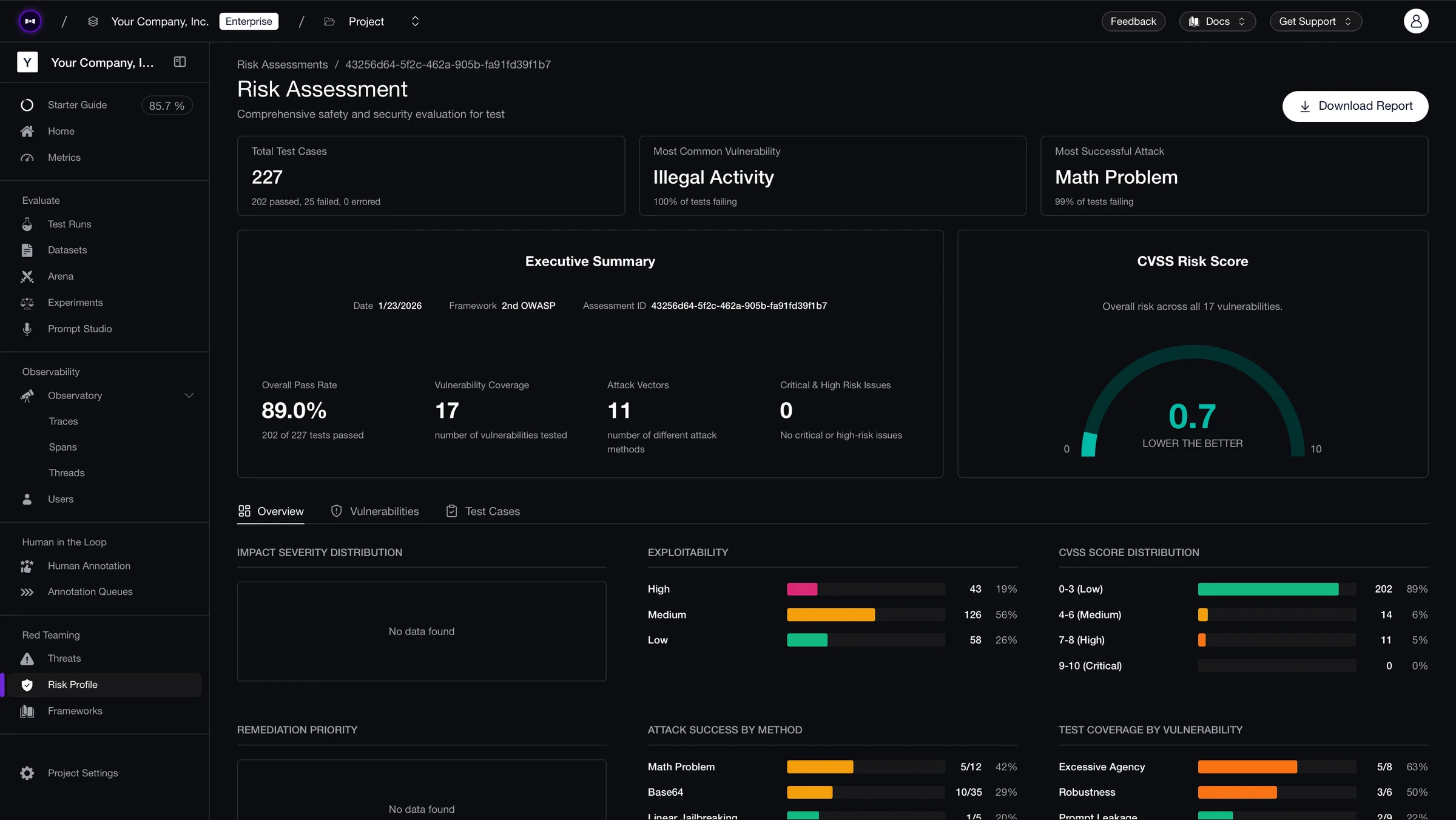
:::info Run EU AI Act Assessments on Confident AI Confident AI lets you configure the EU AI Act framework, schedule recurring risk assessments, manage vulnerabilities in one place, and share downloadable PDF reports with your team for regulatory alignment.
:::
Regulatory obligations beyond adversarial testing
DeepTeam is built to probe how your model behaves under stress for Article 5 and Annex III scenarios. That exercise surfaces technical weaknesses you can fix before deployment — but the EU AI Act also expects organisational, procedural, and documentation controls that no red-team run can replace.
Documentation and traceability
Expect to maintain evidence regulators and customers can inspect, including:
- A risk management system that runs across design, validation, deployment, and major updates — not a one-page checklist.
- Technical documentation that explains the system’s purpose, data, architecture, and performance in enough depth for conformity assessment or internal verification (depending on your pathway).
- Operational logging and records where the Act requires traceability of behaviour in production.
- Instructions for use that tell deployers how to operate the system safely and within its intended context.
Transparency toward users and the public
Depending on how your system is presented and classified, you may need to:
- Disclose machine interaction so people know they are dealing with an AI capability, not only a human service.
- Label or otherwise disclose AI-generated outputs where the Regulation (and implementing rules) require synthetic-media transparency.
- Invest in detection and mitigation for deceptive synthetic content where your product sits in scope for deepfake-related expectations.
Human oversight and meaningful control
High-risk and sensitive deployments are expected to keep humans in charge of outcomes, not just names on an RACI chart:
- Intervention paths that let qualified staff correct, reject, or override model-led recommendations before they cause harm.
- Stop, override, or decommission mechanisms that work in practice under incident conditions, not only in documentation.
- Structured human review for decisions that materially affect rights, safety, or access to essential services.
Quality management and post-market vigilance
After go-live, the Act assumes you continue to govern the system:
- Post-market monitoring to catch drift, misuse, and emerging failure modes in real environments.
- Incident handling and reporting aligned with serious-incident triggers and timelines in the Regulation.
- Conformity and compliance assessment appropriate to your role (provider vs deployer) and the conformity route you follow.
Administrative fines for infringements
National authorities can impose administrative fines tied to the severity of the breach and your worldwide turnover. Indicative upper bands under the Act include:
- Prohibited practices (Article 5): up to €40 million or 7% of global annual turnover, whichever is higher.
- Breaches of obligations for high-risk AI systems: up to €15 million or 3% of global annual turnover, whichever is higher.
- Supplying incorrect, incomplete, or misleading information to notified bodies or regulators: up to €7.5 million or 1% of global annual turnover, whichever is higher.
Exact caps depend on the company category (SME vs non-SME) and the specific infringement — always verify against the consolidated legal text and competent authority guidance.
Phased application of the Regulation
The EU AI Act takes effect in stages from the date of application (check the official journal dates for your planning window). At a high level:
- Early phase (~6 months): rules on prohibited AI practices under Article 5.
- ~12 months: general-purpose AI (GPAI) obligations for relevant models and systemic-risk providers.
- ~24 months: core high-risk AI duties for systems listed in Annex III (subject to specific exceptions in the legal text).
- ~36 months: extended deadlines for certain Annex III use cases and components as specified in the Regulation.
Timelines can be adjusted by corrigenda or delegated acts — treat the official text and Commission notices as the source of truth for your compliance calendar.
Best Practices
- Start from your risk tier. If your system is prohibited under Article 5, remediation (not mitigation) is required; for Annex III systems, run the full set of relevant categories.
- Combine red teaming with governance. EU AI Act obligations cover both technical robustness and documentation — use DeepTeam alongside your risk management system (see Regulatory obligations beyond adversarial testing).
- Test fairness across protected traits. Cover
Bias,Fairness, andEthicsjointly for Annex III categories that affect fundamental rights. - Pair with NIST AI RMF. NIST RMF gives you measurable governance metrics; the EU AI Act gives you the regulatory scope — run them together.
- Re-assess after any material change — new training data, new deployment context, or a new downstream use case can change your risk tier.